
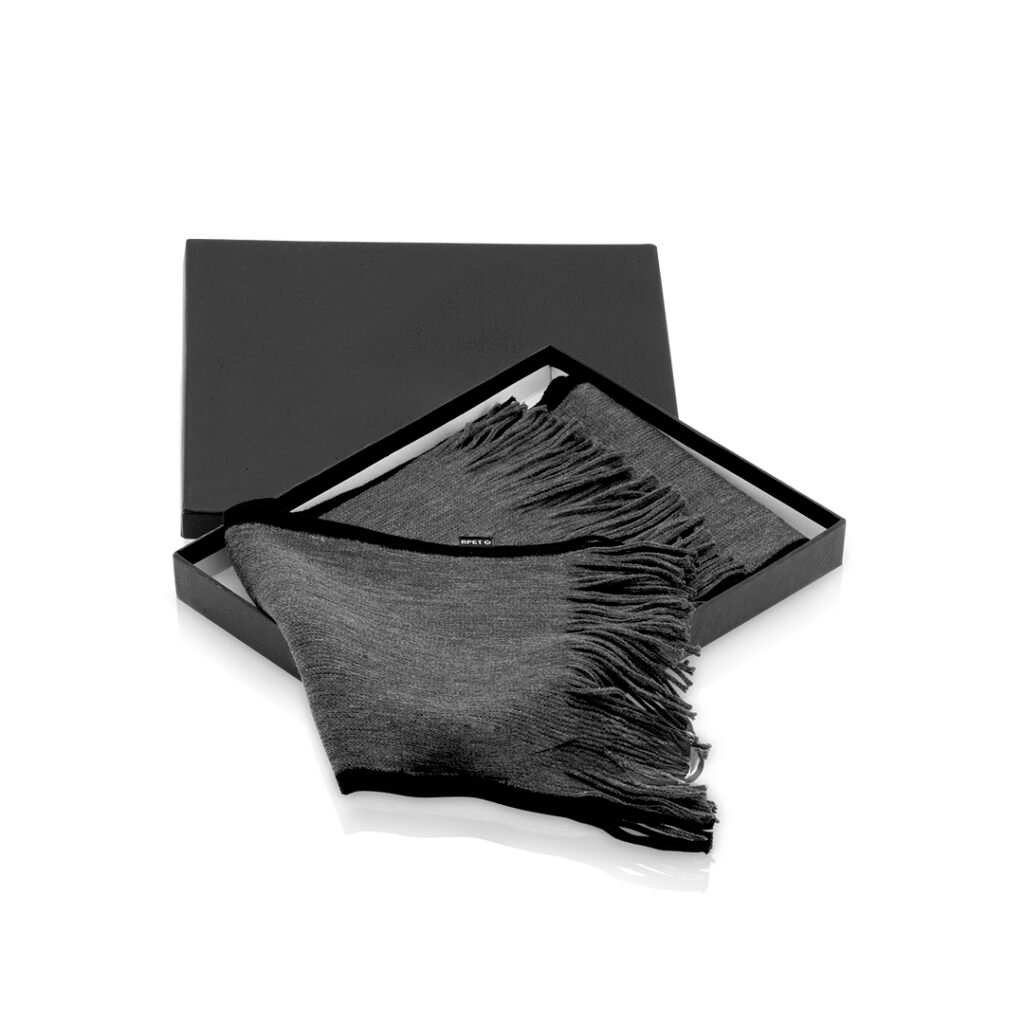
Winter merchandising has a concrete advantage over summer merchandise, and it’s worth understanding because it changes the calculation: it’s worn outside, on top of clothing, for months. It doesn’t get tucked away in a drawer or used in a private setting. It’s displayed, whether the wearer intends it or not, every time they leave the house.
This turns a handful of seemingly simple products into promotional vehicles with considerable reach. These are the five that perform best.
The most efficient of all. It’s worn daily during the cold months, visible in full and from the front, and its cost per unit is low. Additionally, it has a wide range: from a knit beanie for mass distribution to models with UPF50+ sun protection for teams working outdoors.
The finish matters more than it appears. In knit, embroidery is the only technique that lasts: it withstands washing and gives the appearance of a proper garment. Screen printing on knit fabric tends to crack.
The best perceived value in the entire category. It’s voluminous, people touch it before putting it on, and it’s associated with a more expensive gift than it actually is. Made from recycled polar fleece, it also solves the sustainability argument without sacrificing warmth.
It works especially well as a Christmas gift for teams, because it’s one of those garments people appreciate and rarely buy for themselves.
It’s not worn, but it compensates with permanence: it stays on the recipient’s sofa throughout the season, visible to anyone who passes through their home. It’s one of the few promotional products that enters domestic space and stays there.
In RPET polar fleece, the weight is what makes the difference between a blanket that gets used and one that gets folded away in a cupboard. Below 180 g/m² the feel reveals the promotional product.
They solve a real, everyday problem: answering your mobile phone on the street without uncovering your hands. This specific utility means they’re used far more than conventional gloves.
They work very well for campaigns aimed at street sales teams, delivery personnel, construction crews and any team working outdoors. Always check that the touchscreen function is on both the index finger and thumb, not just one.
The largest branding surface in the entire winter catalogue, and the only one that’s visible from above and at a distance. A single umbrella generates exposure to dozens of people every time it rains.
The quality difference is in the frame: fibreglass flexes with gusts and recovers its shape, whereas metal bends or snaps. If it’s for a coastal area or frequent use, fibreglass justifies the extra cost.
The winter campaign overlaps with Christmas, and that saturates sector production from November onwards. If the material is for a year-end campaign, October is the reasonable deadline; after that you’re choosing from what’s left in stock.
For January and February campaigns—sales, winter sports events, street promotions—there’s more leeway, but it’s best not to leave it until after Christmas, when logistics are still struggling with December’s saturation.
The complete selection is in winter merchandising: beanies, scarves, blankets, touchscreen gloves and jackets in organic cotton and RPET polar fleece. Umbrellas have their own section in personalised umbrellas.
If it’s for your team, check out Christmas gifts for employees, and if you want to understand the production schedule, we have a guide on when to order Christmas gifts.
This article is part of our complete guide to corporate Christmas gifts for 2026.
At Greenly we personalise over 1,400 eco-certified products (GOTS, GRS, OEKO-TEX) with your company logo. Free mockup within 24 hours, from 25 units and with no obligation.
Tell us what you need and we'll prepare a bespoke proposal within 24 h.
Request a quote